AI for Oracle DB Professionals: A Simple Mental Model to Cut Through the Noise
1. The Problem / Context
If you are an Oracle DBA or database architect today, you are hearing a constant stream of new AI terminology:
Vector search
LLMs
Agents (often called Agentic AI)
Select AI
Private Agent Factory
In conversations with customers, I see the same pattern repeatedly—strong database expertise, but increasing confusion around how AI fits into the picture.
The natural reaction is:
Where does all of this fit?
Do I need to rethink everything I know about databases?
At the same time, you are still responsible for uptime, performance, and data integrity.
So the real question becomes:
👉 What actually matters—and what is just noise?

2. What People Commonly Hear (or Misunderstand)
Across teams, a few narratives come up consistently:
- “AI requires a completely new stack”
- “Vector databases will replace relational databases”
- “LLMs will replace traditional querying”
- “Agents are the future of everything”
Individually, each of these has some truth.
But without a way to connect them, they tend to create more confusion than clarity.

3. The Reality (A Simple Mental Model)
Instead of thinking in terms of products or features, I’ve found it much easier to explain AI in four layers.
The 4 Layers of Enterprise AI (DB Architect View)
This is the simplest way I’ve found to visualize it:
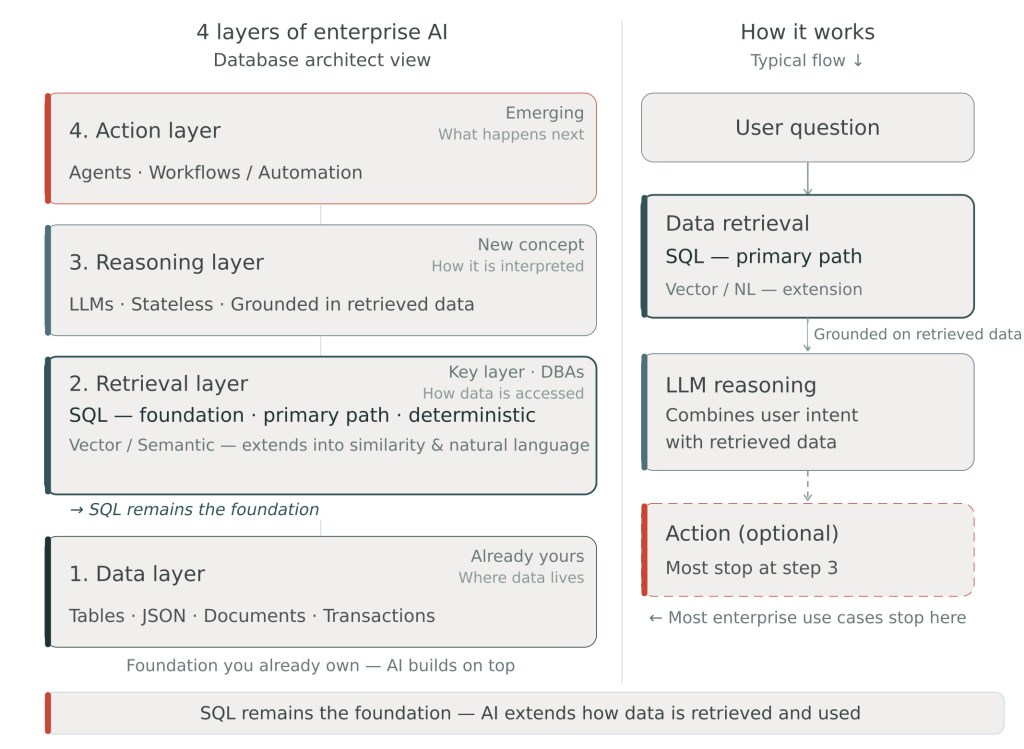
Let’s break this down.
a. Data Layer (You already own this)
Tables, JSON, documents, transactions, and other enterprise data types
This is where enterprise systems—and Oracle—have always been strong.
b. Retrieval Layer (Where SQL has always lived)
This is the most important layer for DB professionals.
For decades, retrieval has meant one thing:
👉 SQL
- Precise
- Deterministic
- Structured
SQL is not new.
It is the foundation of how databases are accessed.
A Subtle but Important Shift
As data evolved, databases expanded beyond relational tables:
- JSON and document data
- Graph relationships
- Spatial and specialized data types
These models have increasingly been consolidated into a single platform.
Oracle is one example of this, where relational, JSON, graph, and other data models coexist within the same database.
What I’m seeing now is another shift—not in the foundation, but in how that foundation is being used.
What’s Evolving in Retrieval
Traditionally, retrieval meant:
- SQL queries returning exact matches
With AI, retrieval is expanding to include new approaches such as:
- Working with unstructured data
- Contextual and similarity-based matching (often implemented through vector representations)
- Natural language interfaces that translate intent into queries
👉 SQL remains the foundation of data retrieval
👉 These new approaches extend how that foundation is used
This is also where platforms like Oracle are evolving—adding capabilities such as vector data types and AI-assisted querying alongside traditional SQL.
c. Reasoning Layer (New concept)
- Large Language Models (LLMs)
Key characteristics:
- Stateless
- Not authoritative
- Dependent on retrieved data
In practice, LLMs don’t replace databases or queries—they rely on them.
d. Action Layer (Emerging)
- Agents
- Workflows
- Automation
This is where execution and orchestration happen.
This is also the area where I see the most experimentation right now, and the most variation across customers.

4. Putting It Together (Without Overcomplicating It)
A simpler way to think about how these pieces work together:
- A user asks a question
- The system retrieves relevant data (primarily using SQL, along with newer retrieval techniques)
- The LLM interprets the question and combines it with the retrieved data
- In some cases, an action is triggered (workflow, API call, update)
Most enterprise use cases I see today stop at step 3.
Even More Simply
At a high level, AI in the database world comes down to three things:
- Getting the right data
- Interpreting it
- Acting on it (when needed)
Everything else—tools, features, and products—fits somewhere into this flow.
The challenge I see is not lack of capability—it’s lack of a clear way to organize it.

5. What This Means for DBAs / Architects
This is the most important takeaway:
👉 AI is not replacing the database
👉 It is being built around and on top of it
If you already understand:
- Data modeling
- Query performance
- Data governance
- System architecture
Then you are already most of the way there.
What changes is the scope of the role.
👉 You are now also thinking about how AI interacts with your data
👉 And ensuring that interaction is accurate, secure, and governed
6. What You Don’t Need to Worry About (Yet)
One thing I consistently see is unnecessary concern about how much needs to change.
You do not need to:
- Train machine learning models
- Understand neural network math
- Rebuild your architecture
- Replace your database platform
What does become increasingly important:
- How AI retrieves and uses data
- Where governance and security apply
- How AI fits into existing systems

7. Practical Guidance (Keep It Grounded)
If you’re trying to get started, keep it simple:
- Focus on how AI interacts with your existing data
- Understand how natural language interfaces connect to SQL
- Become familiar with emerging retrieval patterns such as semantic search
- Map new capabilities to your current architecture
Where I see teams struggle is when they jump too quickly into:
- Agent frameworks
- Tool-specific implementations without a clear model
8. Key Takeaway
AI is not a new stack that replaces the database.
It is a set of capabilities being added around and inside the data platform.
We’ve spent years expanding what data we can store.
👉 AI is now expanding how we retrieve and use that data.
SQL remains the foundation.
New capabilities extend how that foundation is used.
If you understand data, you already understand most of what matters.
👉 The rest is learning how AI uses that data.


Leave a comment